
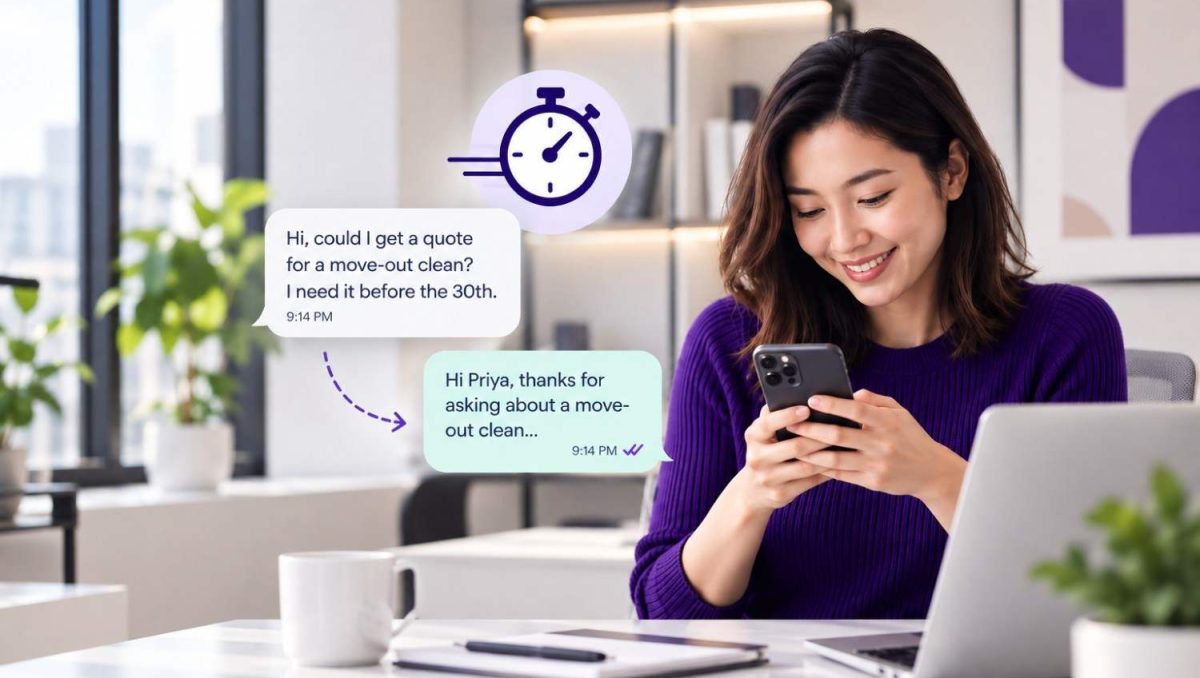
Reply to a new enquiry within five minutes if you can, and within the hour at the very least. Surveys from 2024 and 2026 suggest most businesses manage neither, and the older research that ties speed to sales still points the same way.
What is speed to lead?
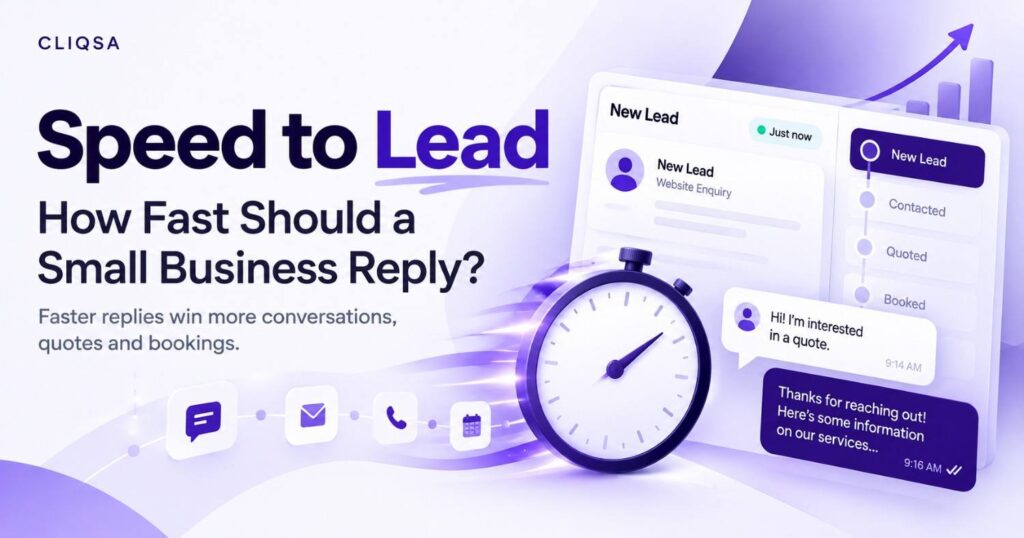
Speed to lead is the time between someone enquiring and your business sending a real reply. The clock starts when the form is submitted, the message arrives or the call goes unanswered. It stops when a person, or a well-built automated message, gives them something useful: a confirmation, an answer, a next step.
It is a revenue number more than a service number. A person who enquires is at their most interested in that moment. Each hour that passes gives the decision time to cool, or to go to someone else.
Decide what counts as a reply before you measure it. Three different events get lumped together, and they tell you different things.
| Event | What it tells you |
|---|---|
| Acknowledgement | The customer knows their enquiry arrived |
| Substantive response | You have answered the request, or asked a question that moves it forward |
| Two-way contact | The person has actually engaged in a conversation with you |
An automatic “thanks for contacting us” is an acknowledgement. It is not a price, a booked slot or a conversation. Track the three separately, or your dashboard will show a ten-second response while customers wait four hours for help.
How fast do businesses reply today?
Fast replies are still the exception. Three studies from 2024 and 2026 show it, and each comes with limits worth knowing.
| Study | Who and how | What it found |
|---|---|---|
| RevenueHero, March 2024 | 1,000 B2B software companies. The team submitted a demo or enquiry form from a separate work email and timed the reply | 36.5% replied at all. Among those that did, the average first reply took about 29 hours (1 day, 5 hours, 17 minutes). 17.2% replied within two minutes and 3.1% within an hour |
| Blazeo, February 2026 | A survey of 573 service businesses in six industries, including home services, real estate and legal. Response times are self-reported | 74% do not respond to new leads within five minutes. 35.4% say a five-minute reply is essential, and 62.1% of those say their team meets that standard |
| Scorpion, February 2026 | Two US surveys run with Dynata in late 2025: 2,000 homeowners who recently hired a tradesperson, and 944 home-services business leaders | 56% of homeowners want 24/7 scheduling or a way to communicate after hours. 66% of business leaders say after-hours service is their top challenge |
Evenings and weekends are a large part of the gap. Blazeo reports that more than 40% of high-intent web enquiries arrive then, and that 24.6% of companies respond slowly or not at all to them.
Now the limits. RevenueHero timed real replies, but to mid-sized software companies, not local businesses, and its author notes that some non-responders may have screened the form out in the background. It also counted automated replies as replies, and about 60% of the companies that responded sent one. Blazeo and Scorpion are surveys, so the figures are what businesses say about themselves. All three are published by companies that sell software or marketing services to this market.
Taken together, they tell you slow replies are common. They do not tell you what a slow reply costs. For that we have to go further back.
What a slow reply costs: the older evidence
None of the 2024 or 2026 studies above followed enquiries through to sales. The studies that did are older, and the numbers quoted most often online come from two of them.
| Study | What it looked at | What it found |
|---|---|---|
| MIT and InsideSales.com Lead Response Management study, 2007, led by James Oldroyd | About three years of data from six companies: over 15,000 leads and over 100,000 call attempts | Calling within 5 minutes instead of 30 made a business roughly 100 times more likely to reach the lead and roughly 21 times more likely to qualify them |
| Harvard Business Review, “The Short Life of Online Sales Leads,” 2011, by Oldroyd, Kristina McElheran and David Elkington | An audit of 2,241 US companies, plus an analysis of about 1.25 million leads at 42 companies | Among companies that replied within 30 days, the average first response took 42 hours, and 23% never replied. Firms that contacted a lead within an hour were nearly 7 times as likely to qualify it as firms that waited one more hour, and over 60 times as likely as firms that waited a day or longer |
You will often see the 100 times and 21 times figures credited to Harvard. They come from the MIT study. The 42 hours and the one-hour comparisons come from the HBR article.
The newer data points the same way, with less rigour. In Blazeo’s survey, 81.2% of companies that take more than an hour to respond said they lose leads, against 46.6% of those that respond within 15 minutes. That is self-reported, it comes from a vendor, and it shows an association, not proof that speed caused the difference.
Now the limits of the older studies. Both are over ten years old. Both looked at companies with sales teams, and the MIT work counted call attempts, not WhatsApp or Instagram replies. We could not find a recent study that follows enquiries to sales at small local service businesses. So read the multipliers as the direction and rough size of the effect, not as a forecast for your pipeline. Your own numbers will tell you more, and the test further down shows you how to get them.
A few figures circulate widely without a traceable source. “78% of buyers choose the first business to respond” is one: none of the pages we checked traced it to a primary study. The 391% conversion lift credited to Velocify is another, because the sources we checked say the original document is not publicly available. We have left both out. If you see them elsewhere, ask where they come from.
Why small businesses reply slowly
Slow replies are rarely a discipline problem. The business is busy doing the work it gets paid for.
Picture the usual setup. The website form sends to a shared inbox that gets checked a few times a day, between jobs. A Facebook message sits in one app, an Instagram DM in another, a WhatsApp in the owner’s phone, a missed call on voicemail. Nobody owns the clock.
The HBR authors, as quoted by SmartCompany, found similar causes in much bigger companies: leads pulled from the CRM once a day instead of continuously, salespeople busy with their own prospecting, and routing rules about who gets which lead. A small business has the same problems with fewer people, plus two of its own. Enquiries arrive across five or six channels, so some are seen late and some never. And they arrive when nobody is looking: evenings, weekends, mid-job.
Two more causes are common. Responsibility is unclear: three people get the notification and each assumes someone else has replied. And the first reply takes more work than it should, because staff retype the same opening questions or ask customers to repeat what they already submitted. Work out which of these is your cause before you buy anything. A shared inbox will not fix unclear ownership, and a faster notification does nothing if nobody is free to act on it.
Trying harder does not fix that. Changing what happens in the first minute, before a person is involved, does.
What slow replies cost a small business
You can size your own exposure with one line of arithmetic:
Revenue at risk per month = enquiries answered late x your usual close rate x average sale value
Here is an example. These numbers are invented to show the sum, so swap in yours.
| Input | Example |
|---|---|
| Enquiries per month | 40 |
| Answered late (hours, not minutes) | 15 |
| Usual close rate | 25% |
| Average sale | $800 |
| Revenue at risk per month | 15 x 0.25 x $800 = $3,000 |
Treat the result as a ceiling, not a loss. Some late leads still buy. What it tells you is whether you are looking at a $200 problem or a $3,000 one, and that decides how much effort the fix deserves.
If you pay for enquiries through ads, divide your monthly ad spend by the number of enquiries you got. That is what each one cost you, and every enquiry that goes cold wastes that amount.
Can an automated reply replace a personal one?
Partly, and it helps to be exact about which part.
The studies that tied speed to sales outcomes measured people contacting leads, mostly by phone. We know of no study showing that an automated message performs as well as a person calling within five minutes, and we would be wary of anyone who says one exists.
What the newer surveys do show is that automation goes with faster replies. In Blazeo’s survey, 62.5% of businesses using AI or automation met a 15-minute response standard, against 39.1% of manual businesses. That is self-reported and from a vendor, and it measures speed, not sales. But it fits what you would expect: a system does not get busy.
What an automated reply can do is hold the lead. It confirms the enquiry arrived, says when a person will follow up, and gives the lead something to do right now, such as picking a time or answering one question. That keeps them engaged through the hours when nobody on your team can reply, which at most small businesses is most of the day.
It fails when it is vague. “Thanks for contacting us, we will be in touch” is a receipt, not a reply. A useful first message does three things: it names what they asked about, it says exactly when a person will respond, and it offers one next step. For example:
Hi Priya, thanks for asking about [service]. Your message reached us at 9:14pm. Someone from the team will reply by 10am tomorrow. If you would rather lock in a time now, pick a slot here: [booking link]. One thing that helps us prepare: [one question]?
Then a person has to reply when the message said they would. The automation buys you time. It does not do the follow-through.
Where automation should hand over to a person
Keep automated and AI-assisted replies to routine questions and collecting details. Hand the conversation to a person when the customer asks for one, when the answer needs judgement, or when pricing, availability or service details cannot be verified. Never let it invent a quote or confirm a booking it cannot actually hold. If a customer is talking to an automated assistant, say so.
A lead response system in three parts
This is how we set it up at CLIQSA for local businesses. The software can vary. The three jobs do not.
- One inbox for every channel. Website forms, WhatsApp, SMS, Facebook and Instagram messages, Google Business messages and call records all land in one place, timestamped and assigned to a person. You cannot reply quickly to an enquiry you have not seen.
- An instant, useful first reply. It fires the moment the enquiry arrives, on the channel it came in on: email for a form, WhatsApp for a WhatsApp message. It follows the three-part structure above.
- Follow-up that does not depend on memory. A lead who goes quiet gets a short sequence over the following days. A lead who books gets a confirmation and a reminder. A lead who cancels gets a message, not silence. A lead who books or declines leaves the sequence, so nobody keeps getting chase messages after they have answered. Everything is logged, so you can see where each person stands.
Two rules hold the three parts together.
First, every open enquiry has a named owner and a backup. A notification sent to five people is not ownership. Agree in advance who steps in when the owner is busy or away.
Second, a missed promise raises an alert. If the reply time you promised passes, the backup or a manager is told. Also check for failed delivery, because a workflow marked complete is no comfort if the customer never received the message.
A follow-up should read like it came from someone who remembers the enquiry:
Hi Priya, is there anything about the quote you would like us to clarify? If your date has changed, let us know and we will check availability again.
Choose the timing to suit the request and the customer’s preferences, and stop when they ask you to.
On timing, the usual order is channels connected in the first week, first replies built and switched on in the second, and follow-up sequences live in weeks three and four.
Test your own response time in 30 minutes
The studies above are averages from other people’s businesses. Before you change anything, find out what a new enquirer actually experiences at yours.
- Submit your own website form from your phone, using a name and number that are not obviously yours.
- Message your business on WhatsApp, Instagram and Facebook from a personal account.
- Call the business line after hours.
- Write down the time you sent each one and the time of the first reply that was actually useful.
- Repeat at three different times: a weekday afternoon, a weekday evening and a weekend morning.
Fill in the gap for each, in minutes:
| Channel | Weekday afternoon | Weekday evening | Weekend morning |
|---|---|---|---|
| Website form | |||
| Instagram DM | |||
| Facebook message | |||
| Phone call |
The longest gap in that grid is your real speed to lead, and the channel it sits in is where to start.
Once you have real enquiries to look at, go one step further. Pull your last 20 genuine ones (use what you have if there are fewer) and record:
- Arrival time and channel
- Acknowledgement time
- Time of the first substantive response
- Whether two-way contact happened
- Whether it ended in a booking or sale, and any known reason it did not
Keep enquiries that arrived during staffed hours separate from overnight ones. List separately any that never got a substantive reply, because they disappear from a report that only averages response times.
Then track the median, the middle result, next to your slowest cases. An average hides the afternoon when three good enquiries waited until the next morning. With a sample this small you can find operational problems, but you cannot prove that response speed alone changed your sales.
Get a free audit of your lead response
Start with one question: if a good enquiry arrived while everyone was busy, what exactly would happen next? If you cannot answer in one sentence, that is the gap.
If you would rather not run this alone, CLIQSA offers a free Business Growth & Automation Audit. In one focused session, a specialist looks at how enquiries reach you today, how fast they get a reply, what follow-up exists and how your CRM is set up. You leave with your three biggest leaks and a specific recommendation for each.
The findings are yours whether or not you work with us. Bring your monthly enquiry numbers and your current follow-up process if you have them.
Book the audit at cliqsa.com.
Frequently asked questions
How fast should a small business reply to a new lead?
Aim for five minutes. That is the window the MIT study measured against, and the gap it found between five and thirty minutes was large. Blazeo’s 2026 survey found 74% of service businesses miss that window, so a business that hits it is ahead of most. If five minutes is unrealistic during the working day, the HBR figures make one hour the line worth protecting. Outside business hours, send an automatic first reply straight away and have a person follow up first thing the next morning. If five minutes is unrealistic today, set a target you can hit every time, then work it down. The worst promise is one your team misses. For a request that needs real work, such as a complex quote, confirm receipt straight away and give a specific time for the answer.
What is the average lead response time?
It depends on who measured and how. RevenueHero timed 1,000 B2B software companies in 2024 and found an average of about 29 hours among those that replied, with 63.5% not replying at all. The 2011 HBR audit found 42 hours. Blazeo’s 2026 survey found 74% of service businesses do not respond within five minutes. None of these is built on small local service businesses, so measure your own with the test above.
Do automated replies make a business feel impersonal?
A vague one does. A message that names the enquiry, gives a time for a human reply and offers a next step is useful to the reader, which is a different thing from impersonal. It stops working when the person then fails to reply when promised.
I already have a CRM. Do I still have this problem?
A CRM stores contacts. Speed to lead depends on whether enquiries reach it on their own and whether anything replies automatically. If someone still has to type the lead in before anything happens, the CRM is not speeding anything up.
What if my enquiries come from several channels?
Start with one inbox. A reply system can only work on the enquiries it can see.
Is this worth doing if I only get a few enquiries a month?
With few enquiries, each one is a bigger share of your month. Use the formula above to size it.
How long does setup take?
Connecting your channels and building the first reply usually takes the first two weeks. Follow-up sequences typically go live in weeks three and four.
Should every enquiry get an immediate phone call?
No. Look at what the person asked for, how they chose to contact you and the time of day. Someone who requested a written quote may be better served by a relevant written reply than an unexpected call.
Can faster replies fix poor conversion?
They fix delays in handling enquiries. They will not fix unsuitable leads, unclear pricing, unavailable slots, or an offer people do not want. Follow the enquiry through to its outcome before deciding what to change.
